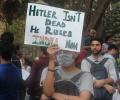
A Supreme Court bench headed by Chief Justice of India S A Bobde, hearing a petition filed by lawyer Vineet Dhanda seeking stern legal action against those disturbing peace and harmony in the country in the name of the Citizenship (Amendment) Act, said, "The country is going through a critical time, the endeavour must be to bring peace and such petitions do not help."

The Left government in Kerala on Thursday withdrew a handbook for police personnel on duty at the Lord Ayyappa temple in Sabarimala after the Bharatiya Janata Party raised a hue and cry over a mention in the book that all pilgrims can enter the temple.

Several FIRs were lodged against Devgan for using a derogatory term for the Sufi saint in the news debate show called '"Aar Paar'" on his channel on June 15.
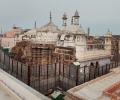
'Why were they silent when over 128 temples and shrines including Shivlings were broken down at the time of the construction of the Kashi Vishwanath corridor?' a Varanasi resident asks Rashme Sehgal.
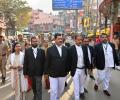
A Varanasi court, which had ordered the videography survey of the Gyanvapi mosque complex, on Tuesday removed advocate commissioner Ajay Mishra on grounds of non-cooperation, an official said.
After the passage of the Eighth Amendment Bill on June 7, 1988, 15 noted personalities had filed a public interest litigation challenging the state religion provision. Many of them are now dead.

After his release, Khan first visited the house of ex-SP MLA Anoop Gupta before departing for his native Rampur.

'What do they gain from making the lives of three children miserable?' 'What do they gain from making a wife cry day and night?'

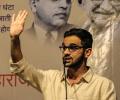
The anti-Citizenship (Amendment) Act protest was secular but the charge sheet in the Delhi riots conspiracy case was communal and the police fabricated a story to suit its narrative, former Jawaharlal Nehru University student leader Umar Khalid told a court in New Delhi on Tuesday calling it a 'naked form of false implication.'

A group of retired civil servants on Tuesday wrote an open letter to Chief Justice of India N V Ramana seeking intervention by the Supreme Court in the alleged illegal detention, bulldozing of residences and police violence in Uttar Pradesh following protests against certain objectionable remarks made by two now-removed Bharatiya Janata Party functionaries.

The Karnataka government told the Supreme Court on Wednesday that the state has not touched any "religious aspect" in the hijab ban row and that the restriction on wearing the Islamic headscarf is limited to the classroom.
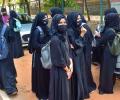
The Supreme Court said on Thursday it is not the 'interpreter' of the Holy Quran and it has been argued before it in the Karnataka hijab ban matter that courts are not equipped to interpret religious scriptures.
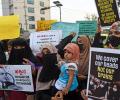
The official order read, 'Kamal Pant, IPS, Commissioner of Police and Additional District Magistrate, Bengaluru City, hereby prohibit any gathering, agitation or protest of any type within the area of 200 metres radius from the gate(s) of the Schools, PU Colleges, Degree Colleges or other similar Educational Institutions in Bengaluru City, for a period of two weeks with immediate effect i.e. from 9-2-2022 to 22-2-2022.'
A bench of Justices D Y Chandrachud, Surya Kant, and P S Narasimha made the important observation during an hour-long hearing of the Gyanvapi mosque dispute and said that it has dealt with provisions of the Places of Worship Act in its 2019 Ayodhya verdict and section 3 does not expressly bar ascertaining of the religious character of the place of worship.

The hijab-row triggered protests in Karnataka spread across the state on Tuesday, with campuses witnessing 'conflict-like' situations marked by stone-pelting incidents, use of force by police and the Muslim girls standing their ground for wearing the headscarves, prompting calls for peace and calm both by the government and the high court, which is now looking into the students' plea for their right to their hijab.
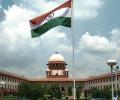
The Supreme Court on Friday said that successful civil services aspirants have no right to be allocated a cadre of their choice or their home state, and also noted that before selection they opt to serve anywhere in the country "with eyes open" but later "scramble" for home cadre.

The 18-year-old actress of the upcoming movie also sought top court's direction to prohibit states from initiating any criminal proceedings against her.

Expressing dissatisfaction over the high court's verdict of dividing the 2.77 acre disputed site into three parts among Muslims, Hindus and Nirmohi Akhara, different religious groups have approached the apex court.
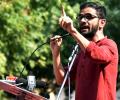
Arguing his bail plea in the riots conspiracy case before additional sessions Judge Amitabh Rawat, his lawyer referred to the supplementary charge sheet filed in the case and said that the police wished to paint every accused with the same brush while adding tadka (flavour) to it.
The police also claimed that the opposition BJP and the political opponents of Thackeray were trying to create an atmosphere to project him as anti-Hindu and not sponsoring the cause of Hinduism, and that in the present regime it was difficult for Hindus to practise their religion freely and thus the feeling of hate would increase against the Muslim religion causing a rift.

The apex court said how can it pass a general order for the whole country.

We celebrate January 26 as Republic Day because that's the day on which we adopted the Constitution in 1950. Yet, in the days preceding and following Republic Day 2021, three different courts violated the Constitutional rights of citizens, observes Jyoti Punwani.

CJI Lalit concurred with the minority view of Justice S Ravindra Bhat who held the EWS quota as "unconstitutional" for excluding poor among SCs, STs and OBCs.

Here is the chronology of events of the case.
The court framed charges against Aam Aadmi Party leader Tahir Hussain and 10 others in the case.

The state government said that none of the actual affected parties, if any, have approached this court concerning the lawful demolition action.
The plea was made before the Department Related Standing Committee for Subordinate Legislation as according to the Manual on Parliamentary Work, the rules for any legislation should be framed within six months of the presidential assent or an extension must be sought.

The verdict by a special court in the Babri Masjid demolition case comes 28 years after kar sevaks razed the 16th century mosque and almost a year after the Supreme Court settled the land case in favour of a Ram temple at the disputed Ayodhya site.
The court will consider issues related to entry of Muslim women into mosques, female genital mutilation in the Dawoodi Bohra Muslim community and barring of Parsi women, married to non-Parsi men, from the holy fire place at Agiary.
Verdicts paving the way for construction of a Ram Temple at Ayodhya and India's multi-billion dollar Rafale fighter jet deal with France were 2019's landmark imprints of the Supreme Court, which also found itself at the centre of a controversy with then Chief Justice of India Ranjan Gogoi being accused of sexual harassment before getting the clean chit.

History would not see the institution kindly if it continues to avoid, as appears to be the case, hearing and deciding some of the most pressing issues of our time, asserts Aakar Patel.

'I am more worried about the rainy season from June.' 'If you don't bury the COVID-19 dead properly, then rainwater will seep into the dead bodies and it will come to our locality where I fear more than 2,000 people will be affected.'

The Supreme Court on Thursday fixed May 11 for commencement of hearing on pleas challenging the validity of triple talaq, 'nikah halala' and polygamy practices among Muslims.

Indian politics, held captive in one way or the other by Ayodhya, may now well seek its emancipation from this issue, and the pursuit of welfare, asserts Congress leader Salman Khurshid in this excerpt from his latest book, Sunrise over Ayodhya.

The court said that the Malayalam folk song has been in the public domain since 1978 and the song video cannot be termed as blasphemous.
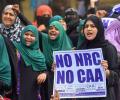
The bench said it will hear petitions pertaining to Assam and Tripura separately as the problem with CAA in these two states is different from rest of the country.

A larger bench of the apex court -- comprising Chief Justice Umar Ata Bandial, Justice Ijazul Ahsan, Justice Mazhar Alam Khan Miankhel, Justice Munib Akhtar and Justice Jamal Khan Mandokhail -- took up the matter after Deputy Speaker Qasim Suri rejected the move to dislodge the prime minister by declaring the no-trust motion unmaintainable due to its link with a so-called foreign conspiracy.

"There is no organ in the human body like a criminal kidney or criminal liver or criminal heart! There is no difference between the organ of a person without a criminal antecedent and the organ of a person who has no criminal antecedents. Human blood is passing through all of us," the Kerala High Court said.

The events that led to the landmark SC judgment.
In the petition, the government stated that the act violates "Articles 14, 21, and 25 of the Constitution of India" and is violative of the basic structure principle of secularism as well.
